
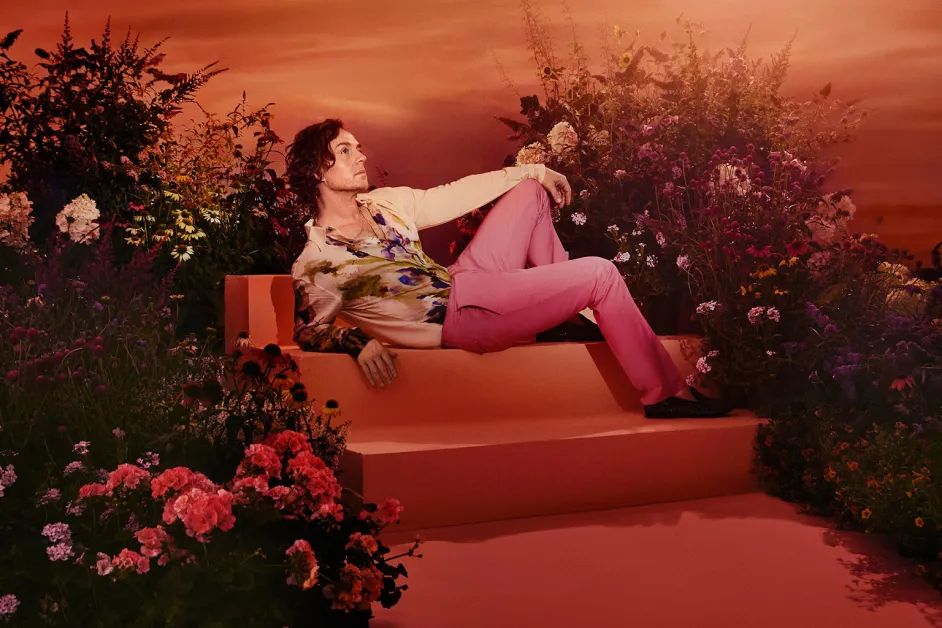
In the article below, Darren Hayes talks about how music executives tried to straightwash him and control his image, thus not allowing him to be his true authentic self.
On how Darren felt about watching openly queer acts rise to fame like Lil Nas X and MUNA:
“I felt a sense of grief because I just thought, ‘Wow, I love how proud, how joyful and how fully formed this generation is,’ and that was not even a possibility for me.”
On Darren’s new album, Homosexual:
“I always felt like I never really was able to have as much control as I wanted to. It took me years, but I was determined to make a record in the vein of the way George Michael made Faith.”
Darren on growing up and enduring the abuse from his alcoholic father (Robert Hayes) towards himself and the domestic violence towards his mother (Judy Hayes):
“The first person who called me — I hate saying this word — ‘faggot’ was my dad, he says, recalling nights when he and his siblings would fight Robert with hockey sticks to stop him from coming after Judy.”
“We would have to almost knock him out so that we could get my mother into a car. We were too young to drive, but my sister would drive the car to motels. We were children that learned how to patch up walls, so there would never be a social worker or anyone that could know.”
Darren did not just face bullying and homophobia from his own father, but he also faced it at school which caused him to suppress his sexuality.
“I didn’t know any gay people. I’d never had any sexual experiences. I just thought, ‘I guess this is just what it is.'”
Shortly after collaborating with Daniel Jones while teaching preschool, Darren wed his high school love, Colby Taylor, in 1994. While they were recording their first album for Savage Garden, Darren found himself in a gay district where he entered a theater to watch gay porn. This experience left him feeling both alarmed and aroused, prompting him to quickly exit the theater, burdened by shame and guilt. This incident led him to reach out to an emotional support hotline, where he was advised, “Honey, you’re gay. You need to go home and tell your wife.”
Fortunately, when Darren confided in his wife, she was understanding. Initially, she thought he was simply bisexual, but as time passed, she came to realize that he was truly gay.
“She thought I was expressing to her, ‘Hey, I’m into men,’ but I don’t think she realized I was really saying, ‘No, I’m realizing that my whole life up to this point has been this thing to please other people.'”
Darren and Colby attempted counseling with a religious therapist, but it did not help with his sexuality. In fact, it caused him emotional distress and made him feel suicidal. In the end, Colby urged Darren to embrace his true feelings, leading to their separation in 1998, and their divorce was finalized two years later. Sadly, during this period, Darren was also experiencing issues with Daniel Jones, which ultimately resulted in the breakup of their band ‘Savage Garden.’
Darren on the breakup of the band and his sexuality:
“What’s really lovely is actually the music and the band was my wonderland. That was my escape. Daniel was incredibly accepting of my identity. It was when Savage Garden ended that my mental health really took a dive. The band was the only thing that was keeping me from really dealing with the fact that, ‘Wow. I have to deal with my sexuality.'”
Darren required extensive therapy and was prescribed medication for his mental health. He also had to begin his own journey, launching a solo career that led to his first album, “Spin,” released in 2002. Sadly, Columbia Records prioritized their sales over Darren’s well-being, focusing more on how his sexuality might affect profits.
“They were obsessed with controlling my image in a way they had never been before.”
A big example of the record labels straightwashing happened during the shooting of his music video “Insatiable.” His original vision for the video was different than theirs; they had filmed an alternate version behind his back and put it all on his tab, which cost Darren Hayes personally around a million dollars. Also, for that music video, they thought his naturally curly hair looked too gay. Silly, I know, so they forced him to straighten it for the filming.
Because the label stopped promoting him, Darren had to move to the United Kingdom in 2004, which seemed to be the only country that accepted him at that time.
“I couldn’t work out, at the time, why I went from having six months of, like, ‘We need you in the country to do all the TV shows and live appearances,’ to suddenly, ‘We’re pulling you from all that stuff. ‘Because I had friends at the label, some of whom were queer, I found out a year or two after the fact what the trickle-down opinion was.”
Following the launch of his fourth album, “Secret Codes and Battleships,” Darren chose to pause his music career. He relocated to Los Angeles, California, with his husband and enrolled in the Groundlings Theater School for a while. During this time, he met his current friend, Johnny Menke, and his wife, Katie Menke, who was expecting a daughter. This daughter, named “Lilah,” would later become Darren’s goddaughter.
Darren had this to say about getting to babysit Lilah for the Menkes during that time:
“I got life, and that managed to pour itself back into my music and gave me that space to look back on my own childhood. I’m so proud of the fact that there’s never been a moment where she’s ever felt anything but loved in my care, and I’m so glad I got to prove that to myself.”
Fortunately after quite the hiatus, Darren would go on to release a new album named “Homosexual” after being moved by a film about a gay romance called “Call Me By Your Name.” The film affected Darren deeply, causing him to leave the theater in tears, which inspired him to create the song “Let’s Try Being In Love.” This album includes elements of Darren’s life and what is important to him, such as themes of his sexuality, his battle with suicidal thoughts, and his tribute to the queer community and those who lost their lives in the Pulse Nightclub shooting in Orlando, Florida, in 2016.
Source: Savage Garden’s Darren Hayes Says Homophobic Music Executives Controlled His Image: ‘I Was Muted’
Kristin’s thoughts: Kudos to Darren for now being brave enough to tell his story and be true to himself. Similar to him, I have faced homophobic comments because of my bisexuality, so I understand how damaging such words can be to one’s self-esteem. I hate that he has gone through such ill treatment.